
📖 View in Flipbook All editions
READING YOUR 7/12: THE ONE COLUMN THAT GIVES THE CLAIM ITS POWER
Every affected society's position can be read off one document — the 7/12 extract. This part explains what to look for on it, and why one column matters more than everything else printed there. The 7/12 extract, named after Sections 7 and 12 of the Maharashtra Land Revenue Code, is the foundational record of who owns and occupies a parcel, its use, and the rights and encumbrances over it. It is maintained by the village talathi, updated on transactions and orders, and available on the State's Bhulekh portal. Lenders, courts and sub-registrars all rely on it — which is why an entry on it carries such practical weight. The extract has an 'occupant' column and an 'other rights' column, and the difference between them is the whole story. The occupant column records the primary land-rights holder — a powerful position. The 'other rights' column is where subordinate interests are noted: encumbrances, mortgages, leases and superior-holder claims. A name in 'other rights' is a claim against the land; a name in 'occupant' is treated as the land-rights holder itself. Across the three revenue villages — Bhayandar, Mire and Ghodbunder — the name in the occupant column is the Estate Investment Company. Congress leader Nana Patole, citing official records in the December 2023 session, put the figure at 8,995 acres. That placement, in occupant rather than 'other rights', is what triggers the NOC demand on every transaction in the belt. Move the same name to 'other rights' and it becomes a claim to be adjudicated, not a gate to be paid at. The record has moved before. Before 2008, following mutation disputes, the company's name had been shifted from 'occupant' to 'other rights' — a demotion that reduced its practical power. The District Collector's order of 5 September 2008 reversed that, directing the name back into the occupant column. Patole alleged in the legislature that the 2008 order was made unauthorisedly and cut against Section 20 of the Urban Land Ceiling Act, and that a December 2015 action recorded 8,995 acres in the company's name, allegedly including government land. The government has pointed to the company's 2017 court injunction as the obstacle to correcting the entry. As Part 14 set out, ordering deemed conveyance is one thing; changing this record entry is the contested step, held by the 2017 injunction. The column is where the dispute actually lives.
React
More from this issue & web
 Page 1
PARLIAMENT CLEARS NCDC AMENDMENT BILL: DIRECT CENTRAL FUNDING OPENS FOR CO-OPERATIVES
Page 1
PARLIAMENT CLEARS NCDC AMENDMENT BILL: DIRECT CENTRAL FUNDING OPENS FOR CO-OPERATIVES
 Page 2
SUPREME COURT TO HEAR MHADA CLUSTER REDEVELOPMENT CASE ON AUGUST 13
Page 2
SUPREME COURT TO HEAR MHADA CLUSTER REDEVELOPMENT CASE ON AUGUST 13
 Page 4
ULC IN REDEVELOPMENT: HOW AN OLD CEILING ENTRY CAN STALL YOUR FSI
Page 4
ULC IN REDEVELOPMENT: HOW AN OLD CEILING ENTRY CAN STALL YOUR FSI
 Page 5
RELOCATION FAILS, IN-SITU WORKS: WHY UBRA REBUILDS PEOPLE WHERE THEY LIVE
Page 5
RELOCATION FAILS, IN-SITU WORKS: WHY UBRA REBUILDS PEOPLE WHERE THEY LIVE
 Page 6
THANE GETS NEW COLLECTORATE AS STATE SCRAPS NA PERMISSION, LAND-FRAGMENTATION LAW
Page 6
THANE GETS NEW COLLECTORATE AS STATE SCRAPS NA PERMISSION, LAND-FRAGMENTATION LAW
 Page 7
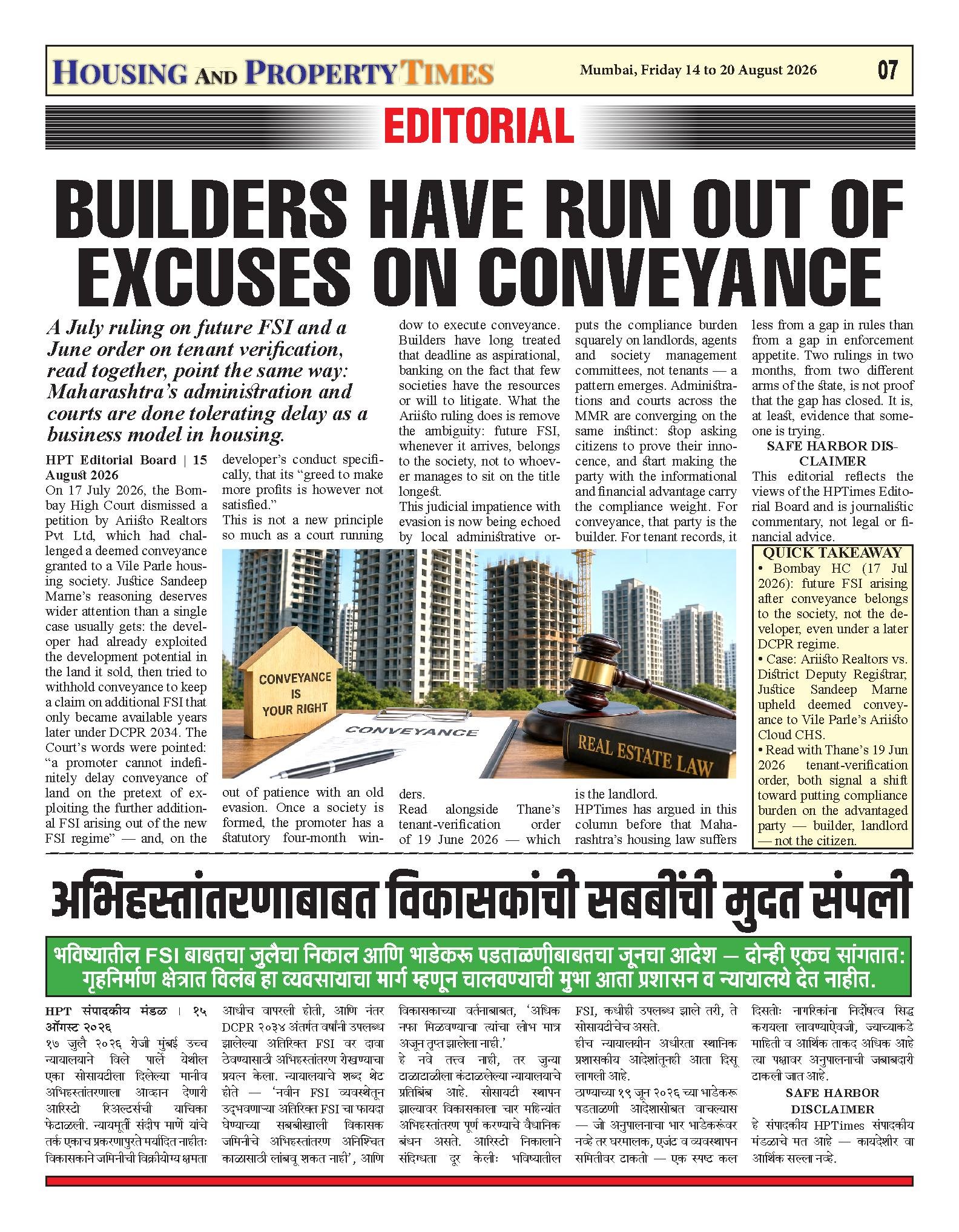
BUILDERS HAVE RUN OUT OF EXCUSES ON CONVEYANCE
Page 7
BUILDERS HAVE RUN OUT OF EXCUSES ON CONVEYANCE
Comments (0)