
📖 View in Flipbook All editions
"IT REWARDS THE LAWBREAKER." THE MORAL HAZARD OBJECTION, ANSWERED.
Every proposal to bring unauthorised buildings within a rehabilitation framework meets the same objection, and it is not a frivolous one. If the state regularises what was built in breach of the law, it announces that breach is survivable. The next promoter, reading that announcement, builds in breach again. Regularisation, on this view, is not a solution to the problem; it is the mechanism that reproduces it. The objection deserves a direct answer rather than a sentimental one, and the answer has three parts. Moral hazard is a claim about incentives. It is therefore falsifiable by looking at what the incentives currently are. Under the present position, an unauthorised building is not demolished in most cases. It is tolerated, taxed in some form, connected to services in many cases, occupied by families for two and three decades, and left in a permanent state of legal suspension. The promoter who built it has, by then, sold every unit, extracted every rupee, and exited. The persons who bear the consequence are the residents, who did not build it and in a very large number of cases did not know it was unauthorised when they bought. That is not an incentive structure that deters promoters. It is an incentive structure that deters nobody and punishes the wrong party. The moral hazard objection, correctly applied, is an argument against the status quo, not against reform. The proposed UBRA framework does not treat the promoter and the resident as the same person, and that is its central design feature. A rehabilitation framework can extend protection to a resident who purchased in good faith while simultaneously preserving — and in fact sharpening — liability against the promoter who constructed in breach. Recovery of the cost of regularisation from the promoter where the promoter is traceable and solvent; attachment of assets; disqualification from future registration; and criminal liability under existing law are all available and are not displaced by protecting the occupant. The objection assumes that relief must be undifferentiated. It need not be. A statute that draws the distinction explicitly does not reward the lawbreaker; it separates the lawbreaker from the person the lawbreaker sold to. The strongest structural answer to moral hazard is a hard, closed and non-renewable eligibility cut-off date, fixed in the statute itself and not extendable by executive order. A framework limited to structures existing on a stated date creates no forward incentive whatsoever, because no building constructed after that date can ever qualify. The hazard argument depends on the expectation of a future amnesty. Remove the expectation and the hazard disappears. What is left is a one-time reconciliation of a historical failure of enforcement — which is what it actually is. It is the repeated, rolling, periodically extended amnesty that creates hazard. A single closed window does not. The distinction is not rhetorical; it is the difference between a statute that solves a problem and a statute that institutionalises it. Part 15 of this series will take up the second major counter-argument: the claim that relocation to alternative housing is preferable to in-situ rehabilitation.
React
More from this issue & web
 Page 1
MAHARERA GRANTS ALL PROJECTS FOUR EXTRA MONTHS OVER WEST ASIA WAR
Page 1
MAHARERA GRANTS ALL PROJECTS FOUR EXTRA MONTHS OVER WEST ASIA WAR
 Page 2
MHADA DREW 2,640 HOMES. 424 OF THEM NOBODY WANTED.
Page 2
MHADA DREW 2,640 HOMES. 424 OF THEM NOBODY WANTED.
 Page 3
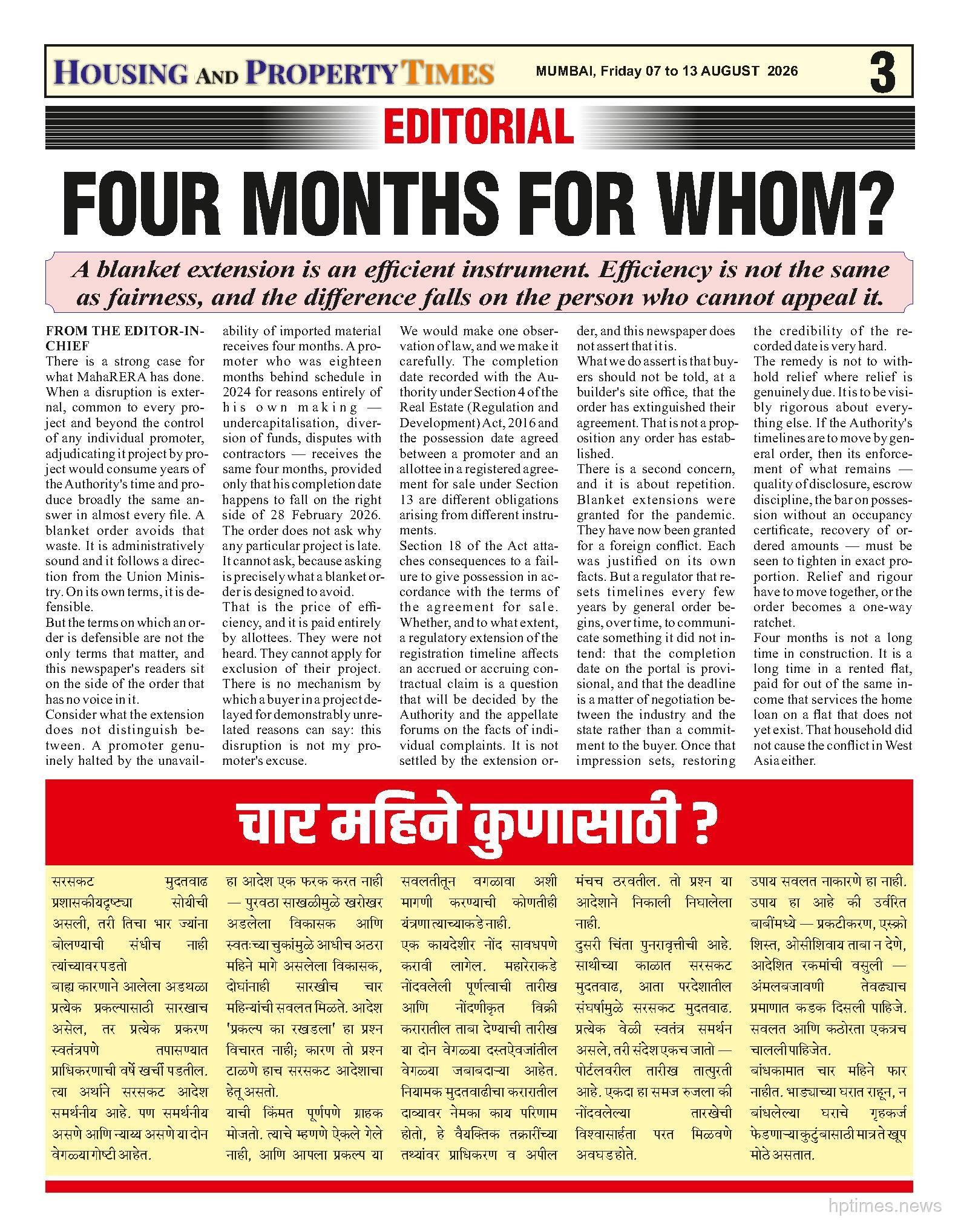
FOUR MONTHS FOR WHOM?
Page 3
FOUR MONTHS FOR WHOM?
 Page 4
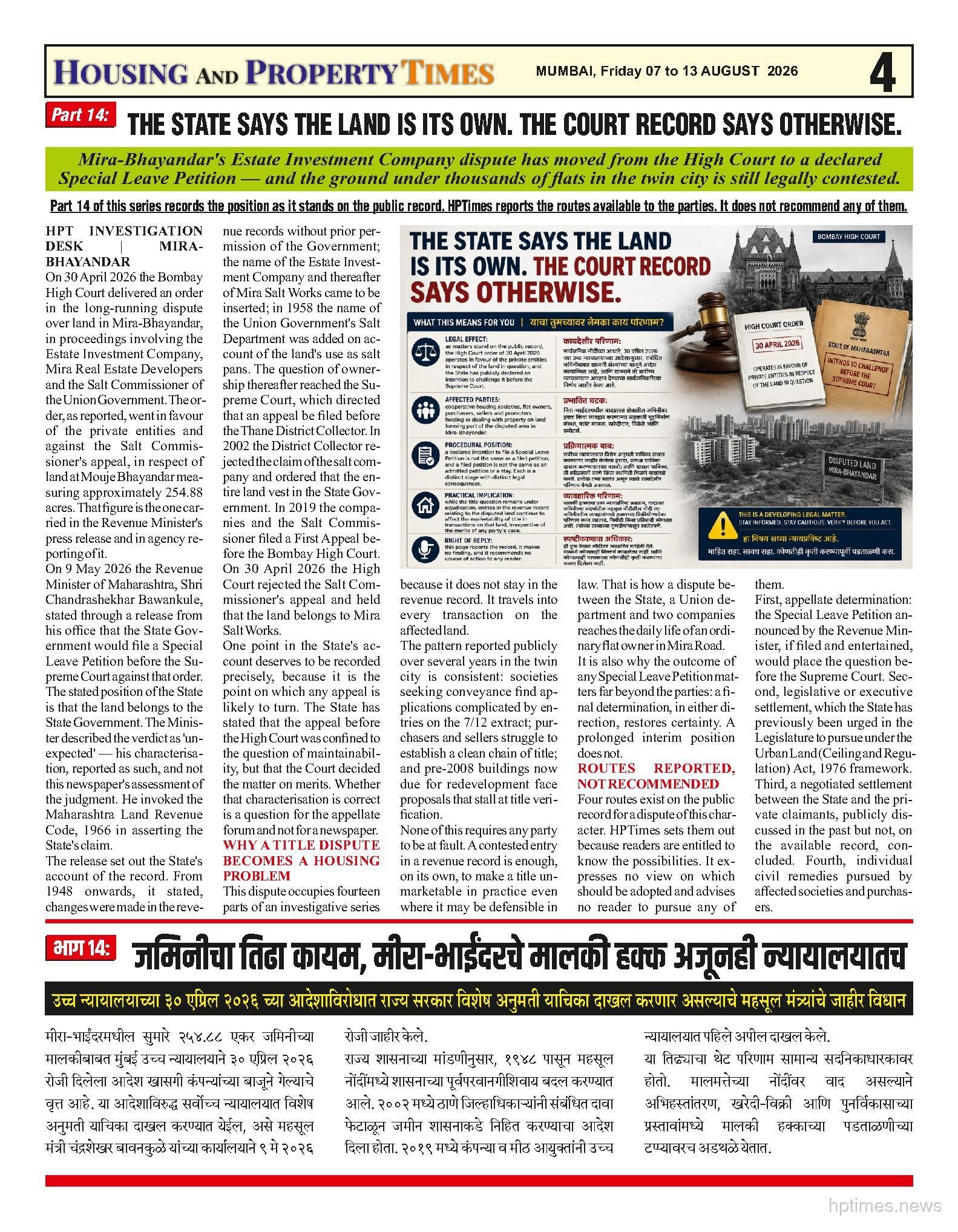
THE STATE SAYS THE LAND IS ITS OWN. THE COURT RECORD SAYS OTHERWISE.
Page 4
THE STATE SAYS THE LAND IS ITS OWN. THE COURT RECORD SAYS OTHERWISE.
 Page 5
THE PREMIUM IS PAID. THE ENCUMBRANCE STAYS. WHY CLEARANCE IS NOT CLOSURE.
Page 5
THE PREMIUM IS PAID. THE ENCUMBRANCE STAYS. WHY CLEARANCE IS NOT CLOSURE.
 Page 7
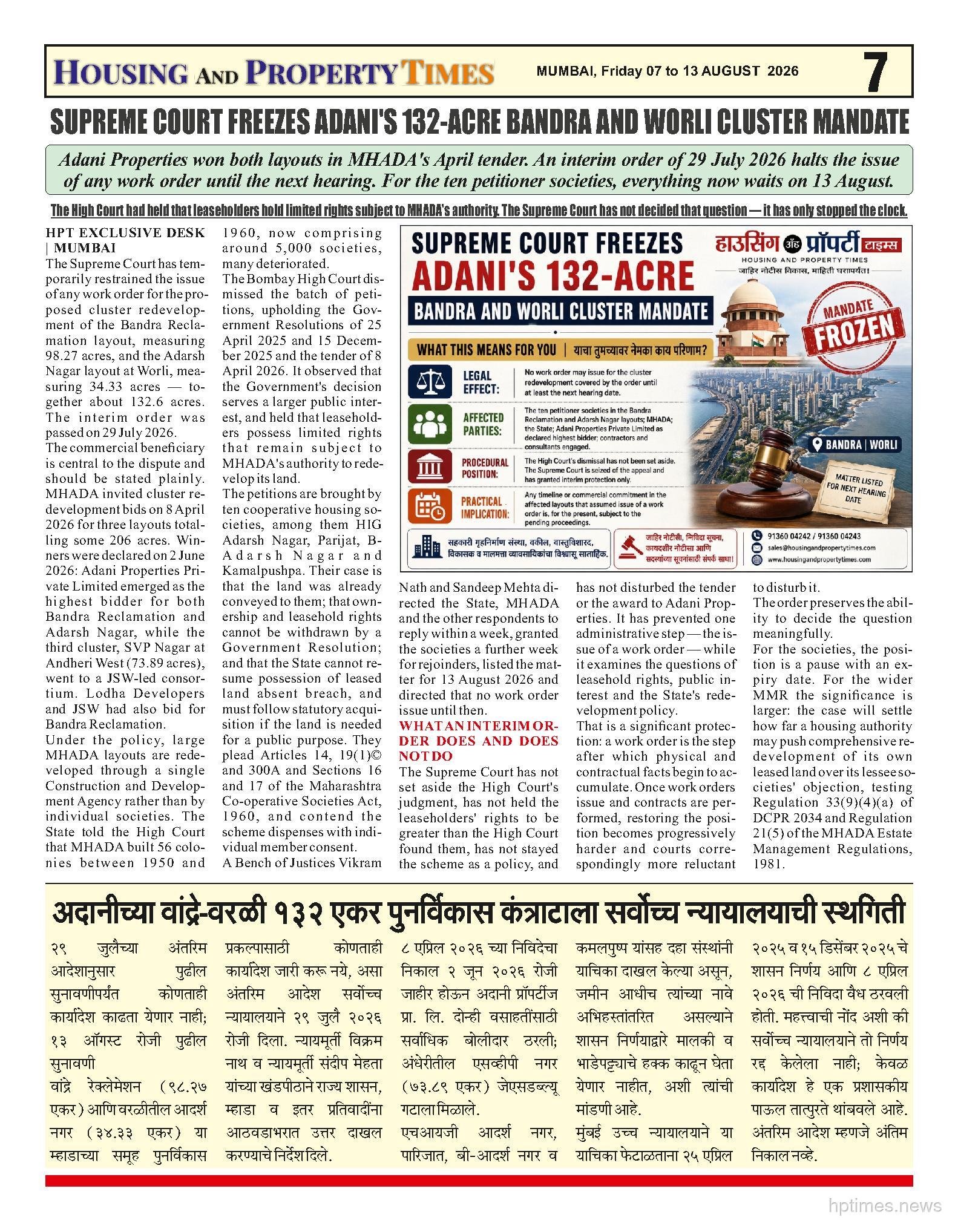
SUPREME COURT FREEZES ADANI'S 132-ACRE BANDRA AND WORLI CLUSTER MANDATE
Page 7
SUPREME COURT FREEZES ADANI'S 132-ACRE BANDRA AND WORLI CLUSTER MANDATE
Comments (0)