📖 View in Flipbook All editions
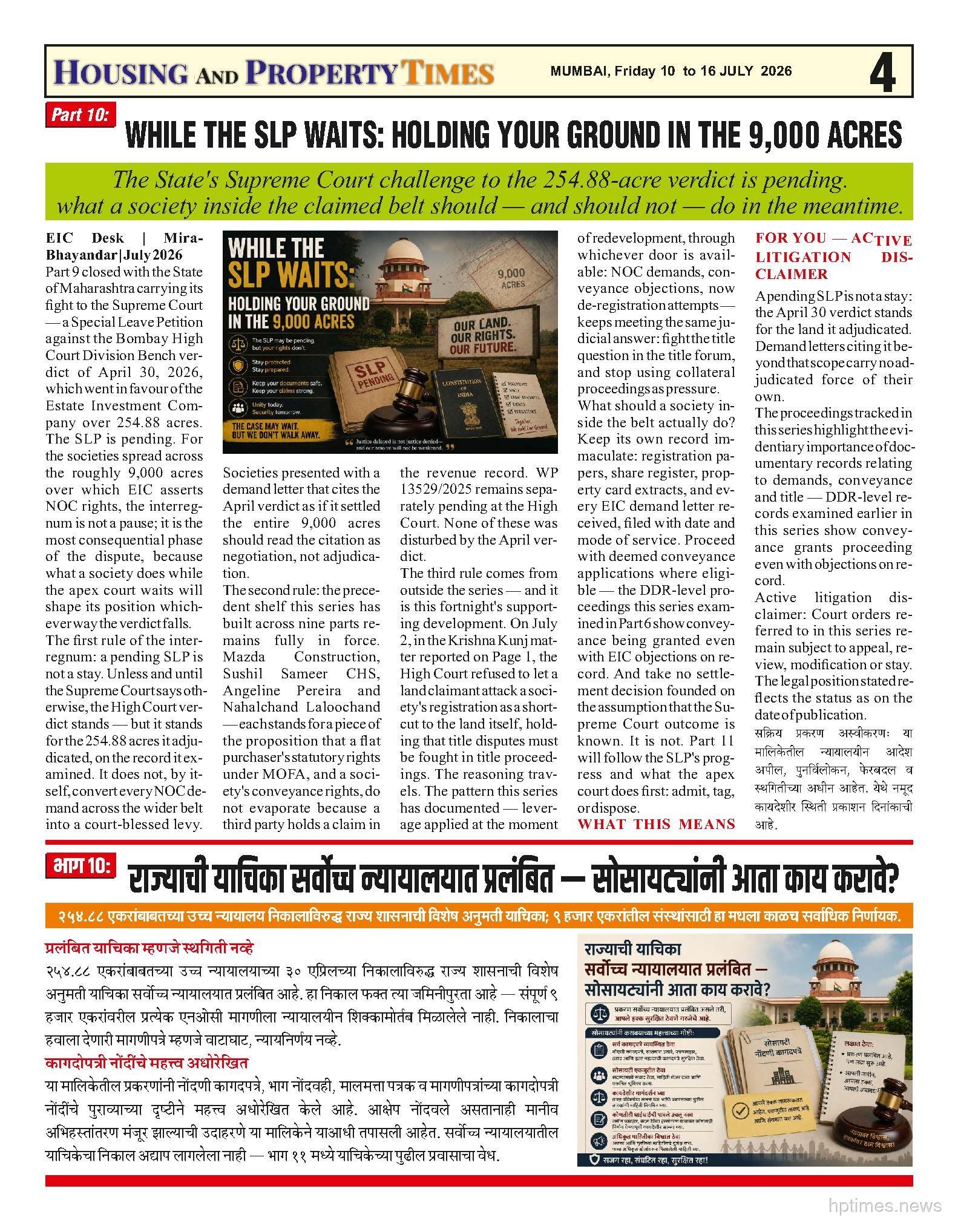
AFTER THE CORRECTION: WHAT TO DEMAND AT THE COLLECTOR'S TABLE
Part 9 of this series closed on the Bombay High Court's correction of March 30, 2023 — the ruling that confined the clearance premium to surplus vacant land only, ending the practice of computing premium on the entire plot. Part 10 addresses the question readers have asked since: with the legal chain now settled, what exactly should an individual plot owner place on the table at the Collector's office, and what should the owner refuse to accept? The chain itself bears one-line restatement, because every document in the owner's file hangs from it. The Supreme Court's order of July 2, 2019 settled the state's power to levy a premium for clearing Urban Land Ceiling encumbrances. The Maharashtra Government Resolutions of August 1, 2019 and June 23, 2021 fixed the mechanism and the rates — 13 per cent of ready reckoner value for residential land, 15 per cent for industrial. The circular of January 12, 2022 extended the route to individual plot owners, not just developers of layouts. And the High Court's March 2023 correction confined the computable base to the surplus vacant land recorded in the ULC proceedings — not the built-up portion, not the whole survey number. From that chain, the owner's entitlements follow. The premium can lawfully attach only to what the ULC proceedings identified as surplus — making the certified extract of the original declaration the foundational document. The law contemplates a written computation showing the area taken as base, the applicable ready reckoner rate and year, and the percentage applied. And where an office computes on the full plot area, the March 2023 correction is the governing authority against which that computation stands or falls; a written objection on record documents the divergence. One exception from the series record bears repeating for industrial plot holders: where land subject to ULC proceedings is transferred for the same industrial purpose, no premium applies — the 15 per cent rate attaches only on change of use. An office computing premium on a same-purpose industrial transfer is computing on the wrong side of the rule. Equally clear is what the legal chain does not support. An oral demand with no computation sheet has no basis in the framework. A premium computed at rates other than 13/15 per cent, or on a ready reckoner year that inflates the base, diverges from the GRs. And refusal to accept an application from an individual owner — on the old theory that the route belongs only to developers — is contrary to the January 2022 circular. The pattern this series has documented since Part 1 has not changed: the law has been clarified faster than counter practice. The gap between the two is precisely where owners' outcomes diverge — and the documentary chain of SC order, two GRs, circular and HC correction is what closes it.
React
More from this issue & web
 Page 1
SOCIETY REGISTRATION IS NOT A LAND-GRAB TARGET, RULES BOMBAY HC
Page 1
SOCIETY REGISTRATION IS NOT A LAND-GRAB TARGET, RULES BOMBAY HC
 Page 2
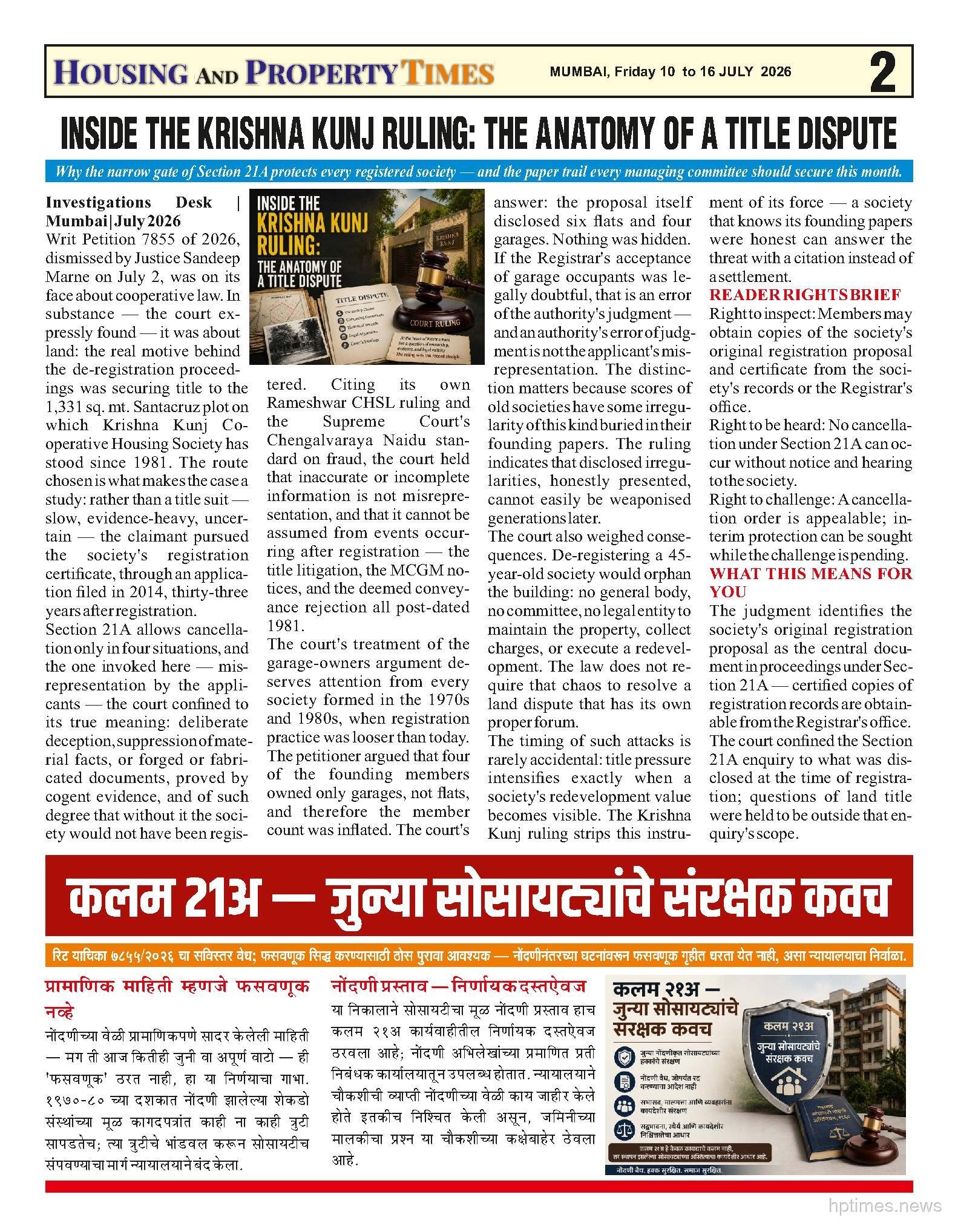
INSIDE THE KRISHNA KUNJ RULING: THE ANATOMY OF A TITLE DISPUTE
Page 2
INSIDE THE KRISHNA KUNJ RULING: THE ANATOMY OF A TITLE DISPUTE
 Page 3
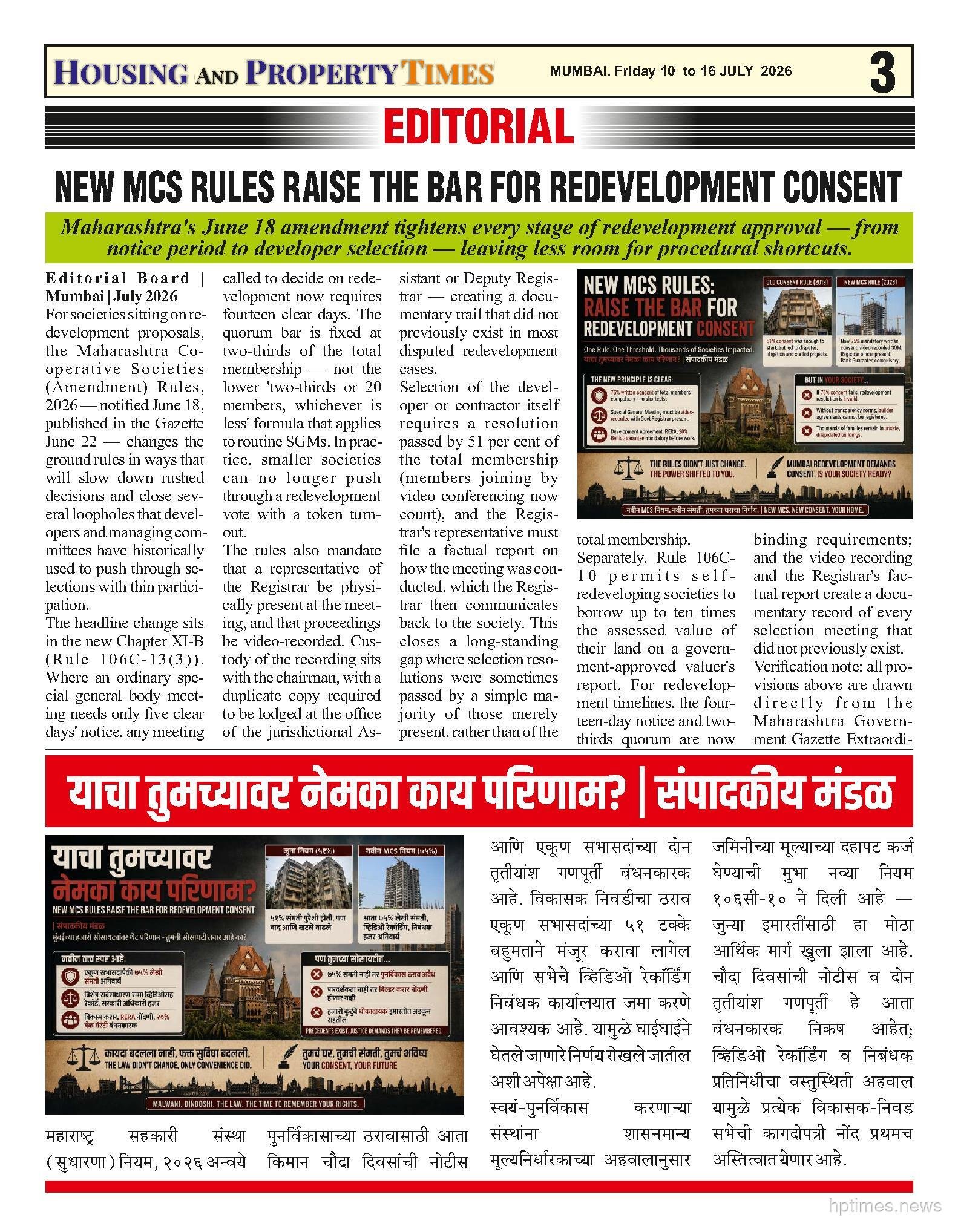
WHILE THE SLP WAITS: HOLDING YOUR GROUND IN THE 9,000 ACRES
Page 3
WHILE THE SLP WAITS: HOLDING YOUR GROUND IN THE 9,000 ACRES
 Page 5
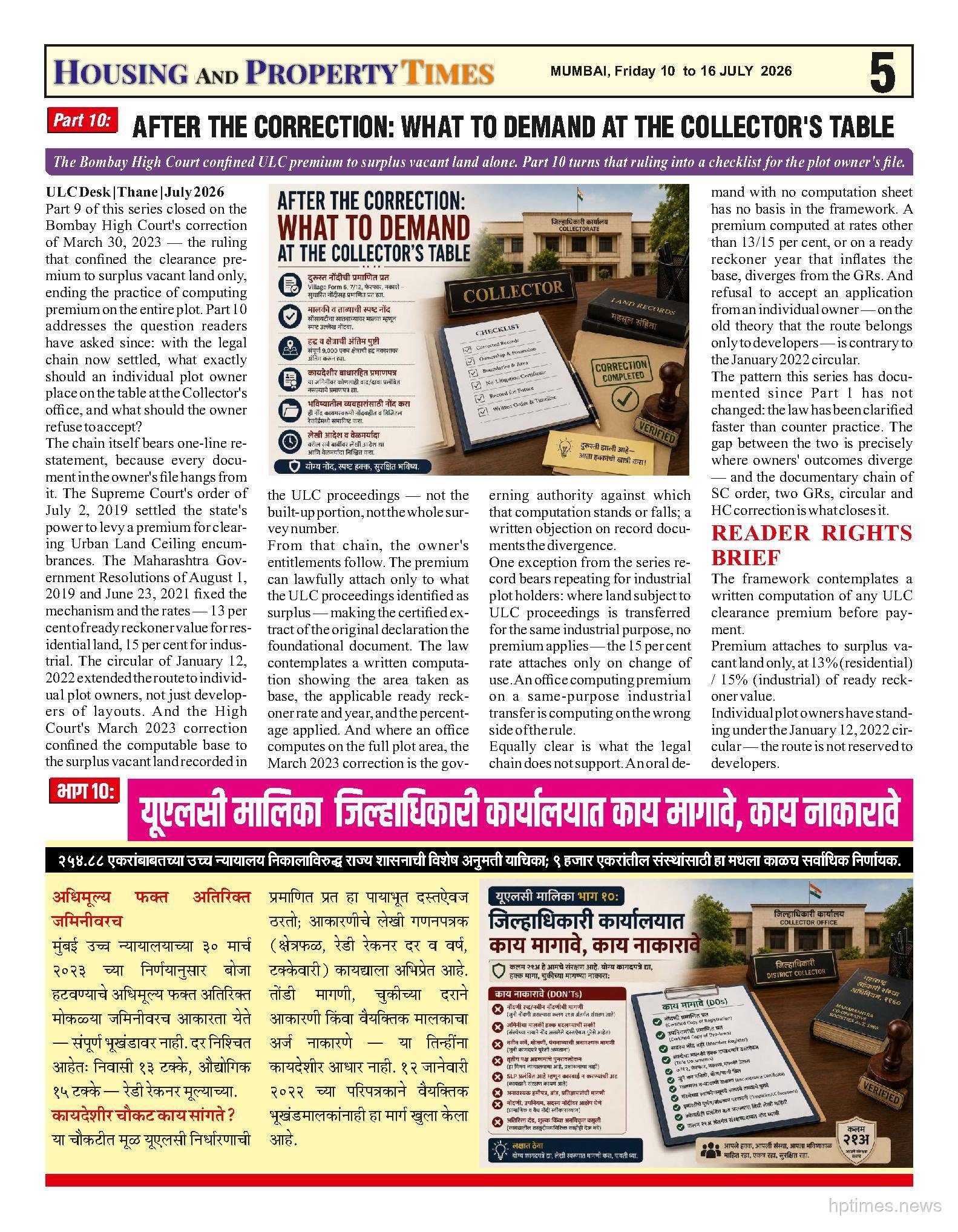
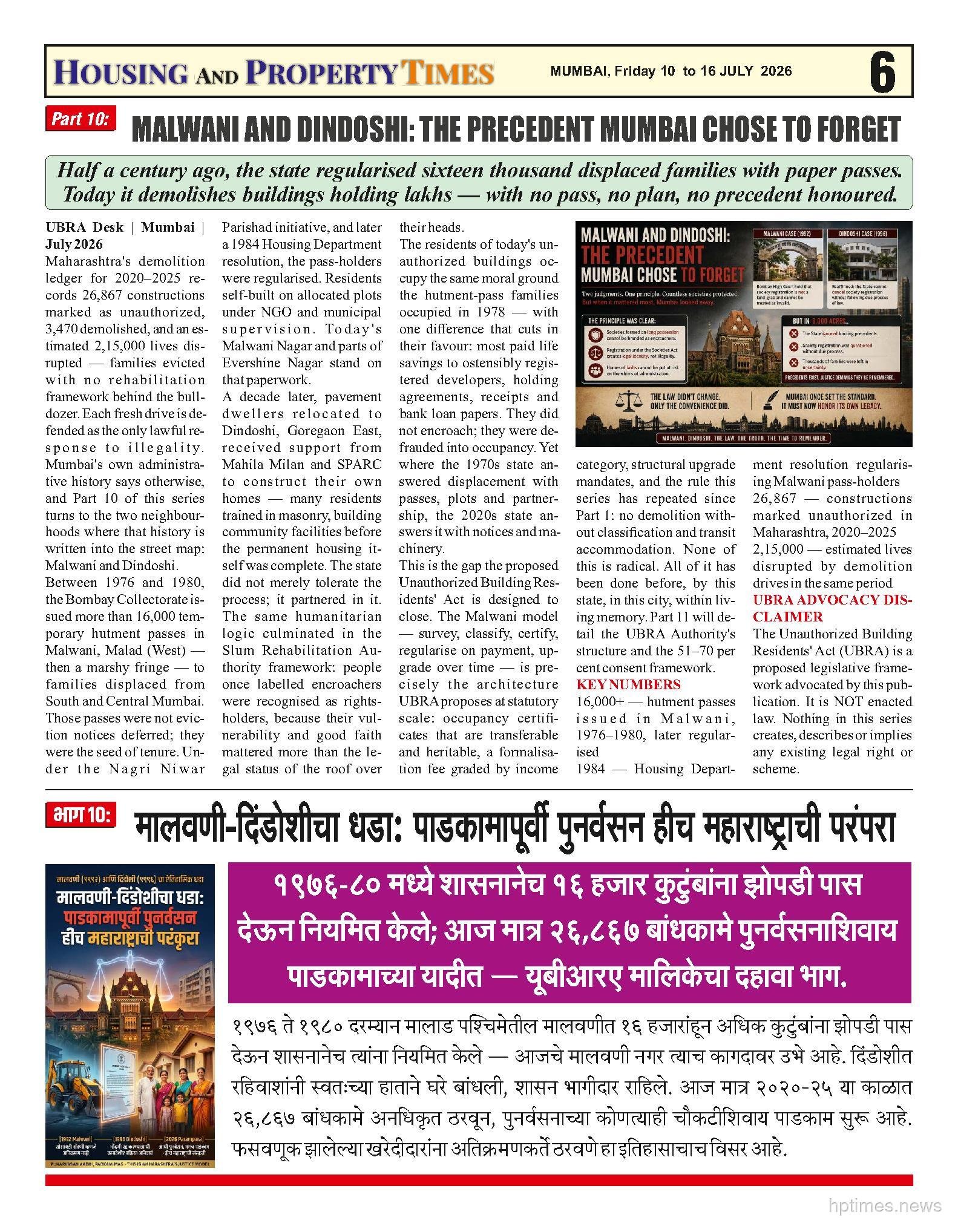
MALWANI AND DINDOSHI: THE PRECEDENT MUMBAI CHOSE TO FORGET
Page 5
MALWANI AND DINDOSHI: THE PRECEDENT MUMBAI CHOSE TO FORGET
 Page 6
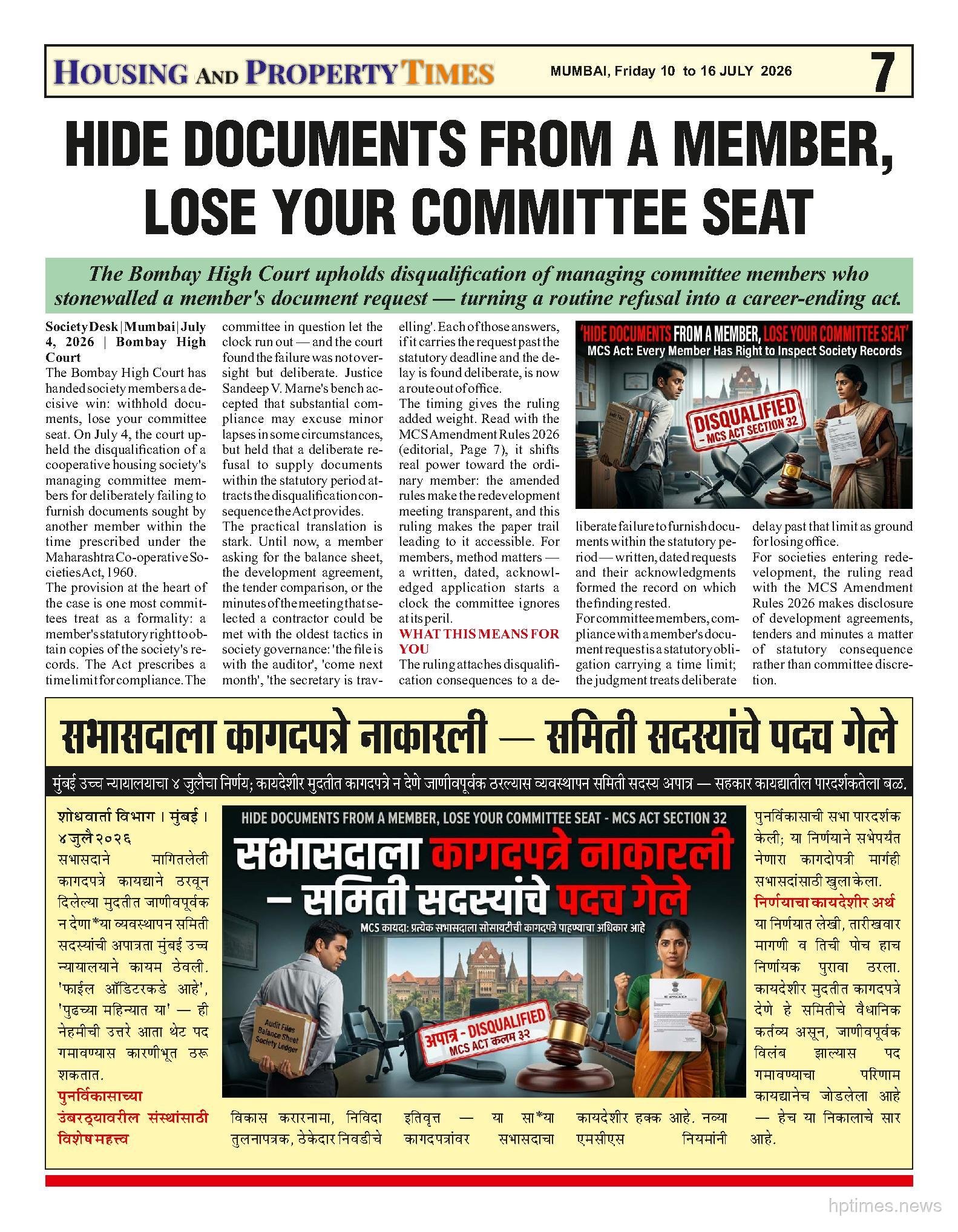
HIDE DOCUMENTS FROM A MEMBER, LOSE YOUR COMMITTEE SEAT
Page 6
HIDE DOCUMENTS FROM A MEMBER, LOSE YOUR COMMITTEE SEAT
 Page 7
NEW MCS RULES RAISE THE BAR FOR REDEVELOPMENT CONSENT
Page 7
NEW MCS RULES RAISE THE BAR FOR REDEVELOPMENT CONSENT
Comments (0)