📖 View in Flipbook All editions
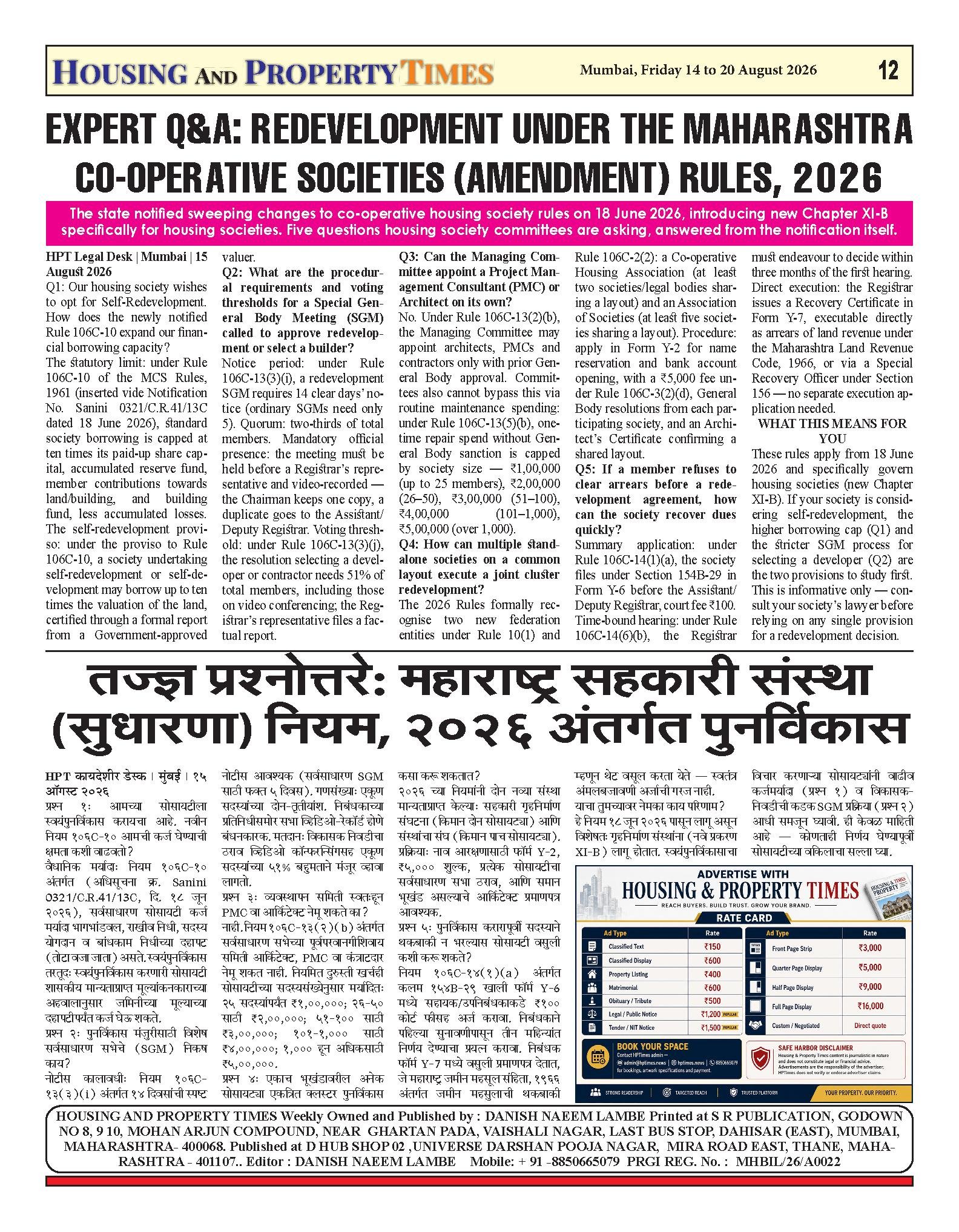
ADVERTISE WITH HOUSING & PROPERTY TIMES — RATE CARD (bottom strip)
What this means for you: Classified Text — ₹150
Q1: Our housing society wishes to opt for Self-Redevelopment. How does the newly notified Rule 106C-10 expand our financial borrowing capacity? The statutory limit: under Rule 106C-10 of the MCS Rules, 1961 (inserted vide Notification No. Sanini 0321/C.R.41/13C dated 18 June 2026), standard society borrowing is capped at ten times its paid-up share capital, accumulated reserve fund, member contributions towards land/building, and building fund, less accumulated losses. The self-redevelopment proviso: under the proviso to Rule 106C-10, a society undertaking self-redevelopment or self-development may borrow up to ten times the valuation of the land, certified through a formal report from a Government-approved valuer. Q2: What are the procedural requirements and voting thresholds for a Special General Body Meeting (SGM) called to approve redevelopment or select a builder? Notice period: under Rule 106C-13(3)(i), a redevelopment SGM requires 14 clear days' notice (ordinary SGMs need only 5). Quorum: two-thirds of total members. Mandatory official presence: the meeting must be held before a Registrar's representative and video-recorded — the Chairman keeps one copy, a duplicate goes to the Assistant/Deputy Registrar. Voting threshold: under Rule 106C-13(3)(j), the resolution selecting a developer or contractor needs 51% of total members, including those on video conferencing; the Registrar's representative files a factual report. Q3: Can the Managing Committee appoint a Project Management Consultant (PMC) or Architect on its own? No. Under Rule 106C-13(2)(b), the Managing Committee may appoint architects, PMCs and contractors only with prior General Body approval. Committees also cannot bypass this via routine maintenance spending: under Rule 106C-13(5)(b), one-time repair spend without General Body sanction is capped by society size — ₹1,00,000 (up to 25 members), ₹2,00,000 (26–50), ₹3,00,000 (51–100), ₹4,00,000 (101–1,000), ₹5,00,000 (over 1,000). Q4: How can multiple standalone societies on a common layout execute a joint cluster redevelopment? The 2026 Rules formally recognise two new federation entities under Rule 10(1) and Rule 106C-2(2): a Co-operative Housing Association (at least two societies/legal bodies sharing a layout) and an Association of Societies (at least five societies sharing a layout). Procedure: apply in Form Y-2 for name reservation and bank account opening, with a ₹5,000 fee under Rule 106C-3(2)(d), General Body resolutions from each participating society, and an Architect's Certificate confirming a shared layout. Q5: If a member refuses to clear arrears before a redevelopment agreement, how can the society recover dues quickly? Summary application: under Rule 106C-14(1)(a), the society files under Section 154B-29 in Form Y-6 before the Assistant/Deputy Registrar, court fee ₹100. Time-bound hearing: under Rule 106C-14(6)(b), the Registrar must endeavour to decide within three months of the first hearing. Direct execution: the Registrar issues a Recovery Certificate in Form Y-7, executable directly as arrears of land revenue under the Maharashtra Land Revenue Code, 1966, or via a Special Recovery Officer under Section 156 — no separate execution application needed. Classified Display — ₹600 Property Listing — ₹400 Matrimonial — ₹600 Obituary / Tribute — ₹500 Legal / Public Notice — ₹1,200 (POPULAR) Tender / NIT Notice — ₹1,500 (POPULAR) Front Page Strip — ₹3,000 Quarter Page Display — ₹5,000 Half Page Display — ₹9,000 Full Page Display — ₹16,000 Custom / Negotiated — Direct quote Contact HPTimes admin — admin@hptimes.news | hptimes.news | 8850665079 — for bookings, artwork specifications and payment.
React
More from this issue & web
 Page 1
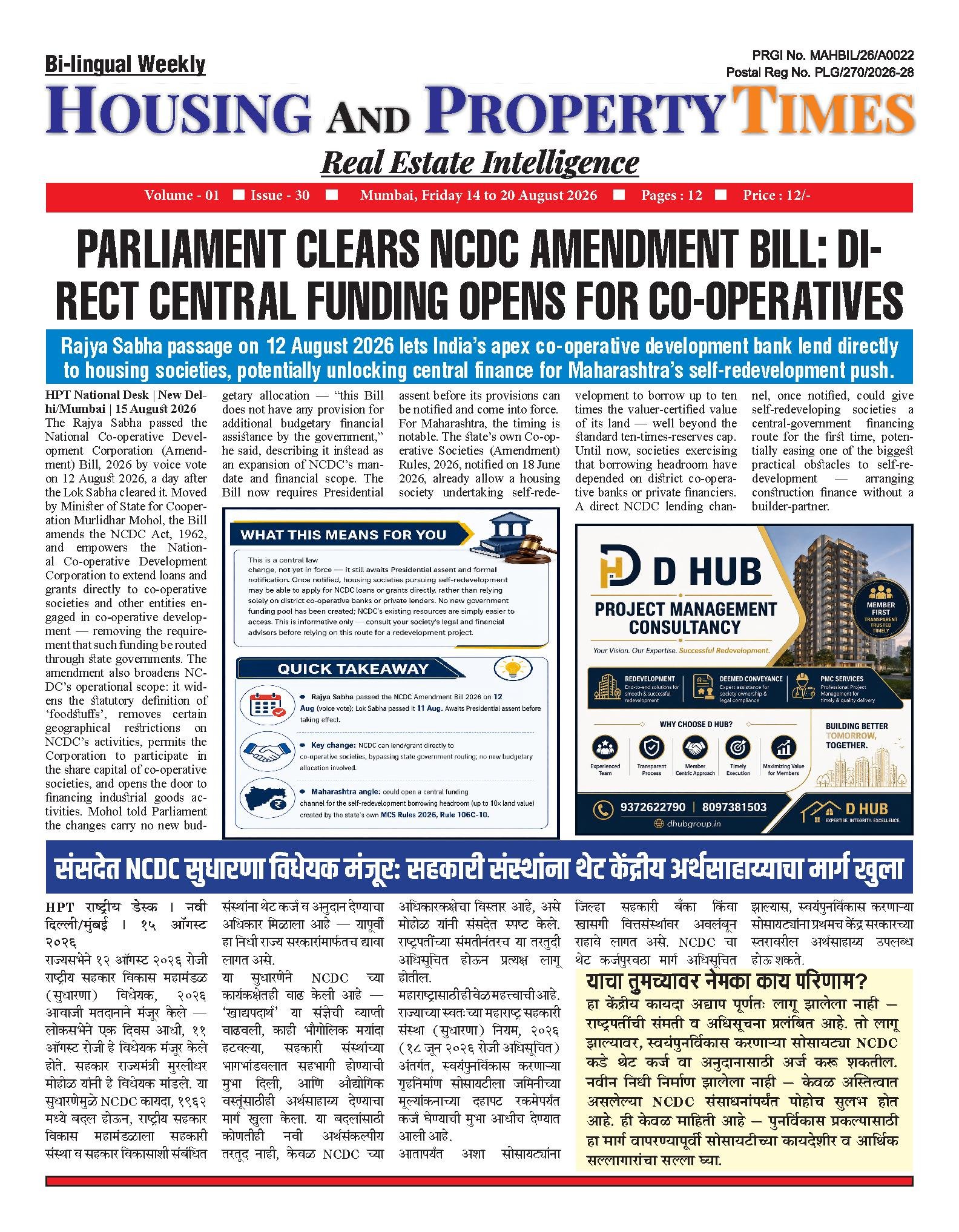
D HUB — PROJECT MANAGEMENT CONSULTANCY (locked ad, right 40%)
Page 1
D HUB — PROJECT MANAGEMENT CONSULTANCY (locked ad, right 40%)
 Page 2
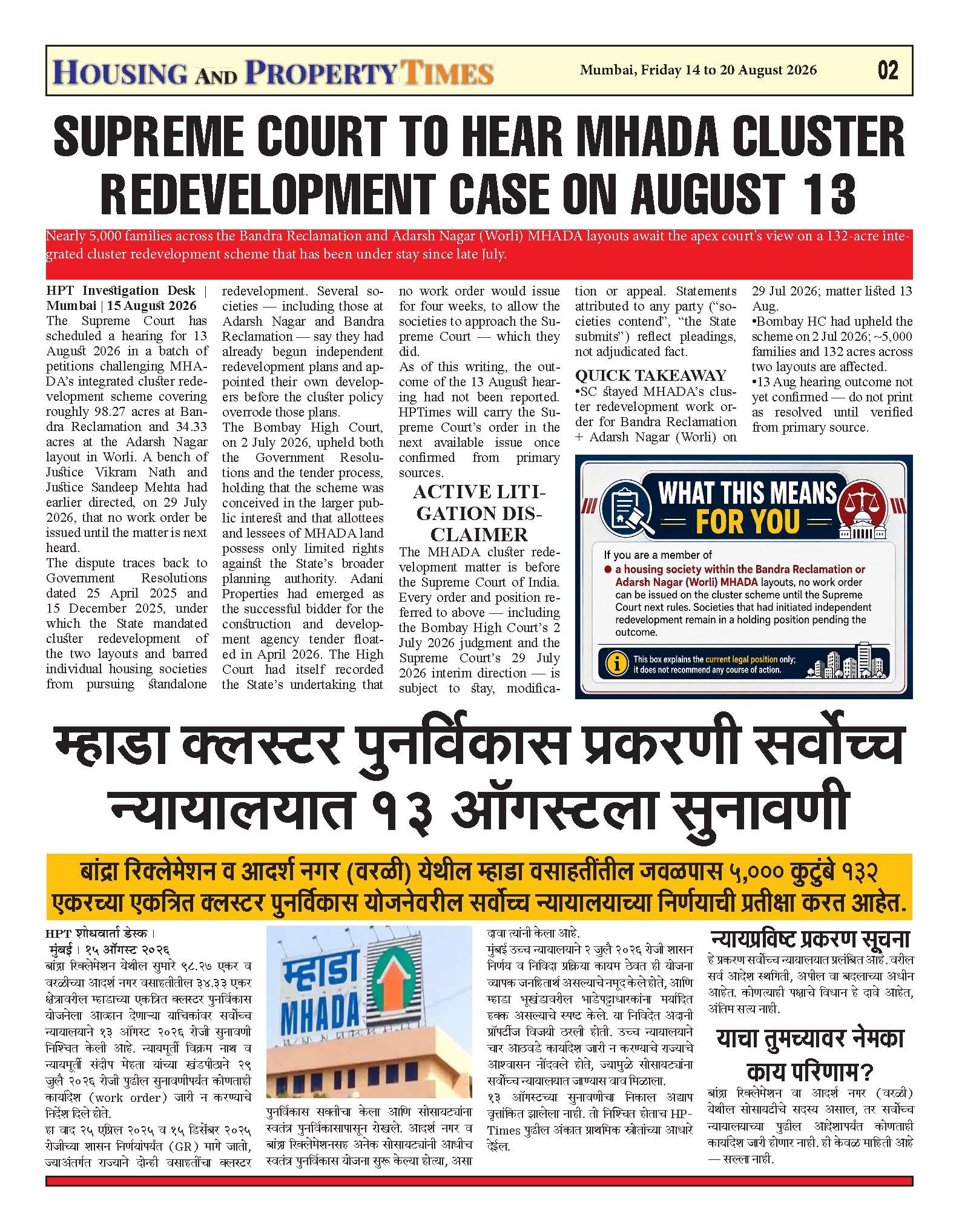
SUPREME COURT TO HEAR MHADA CLUSTER REDEVELOPMENT CASE ON AUGUST 13
Page 2
SUPREME COURT TO HEAR MHADA CLUSTER REDEVELOPMENT CASE ON AUGUST 13
 Page 3
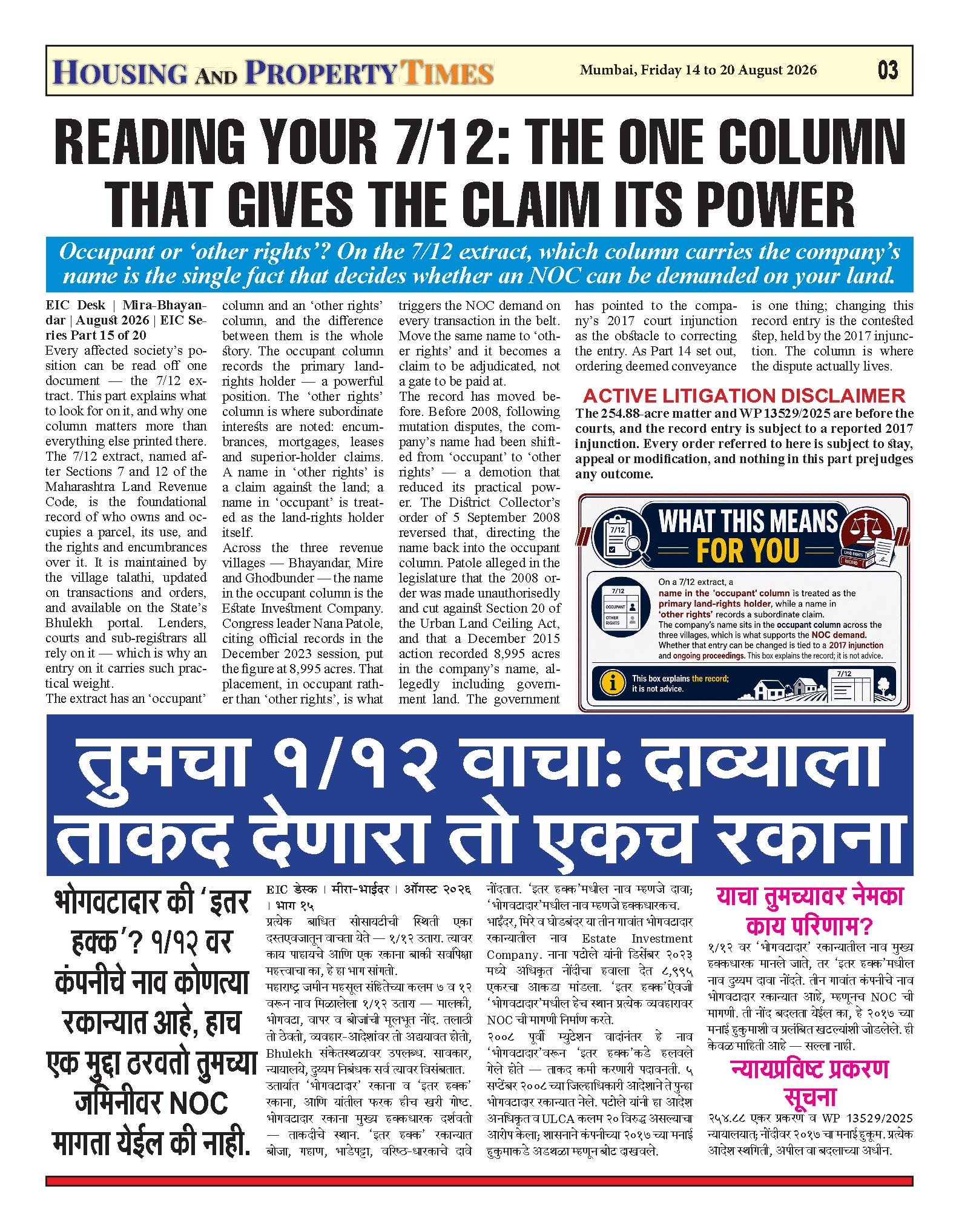
READING YOUR 7/12: THE ONE COLUMN THAT GIVES THE CLAIM ITS POWER
Page 3
READING YOUR 7/12: THE ONE COLUMN THAT GIVES THE CLAIM ITS POWER
 Page 4
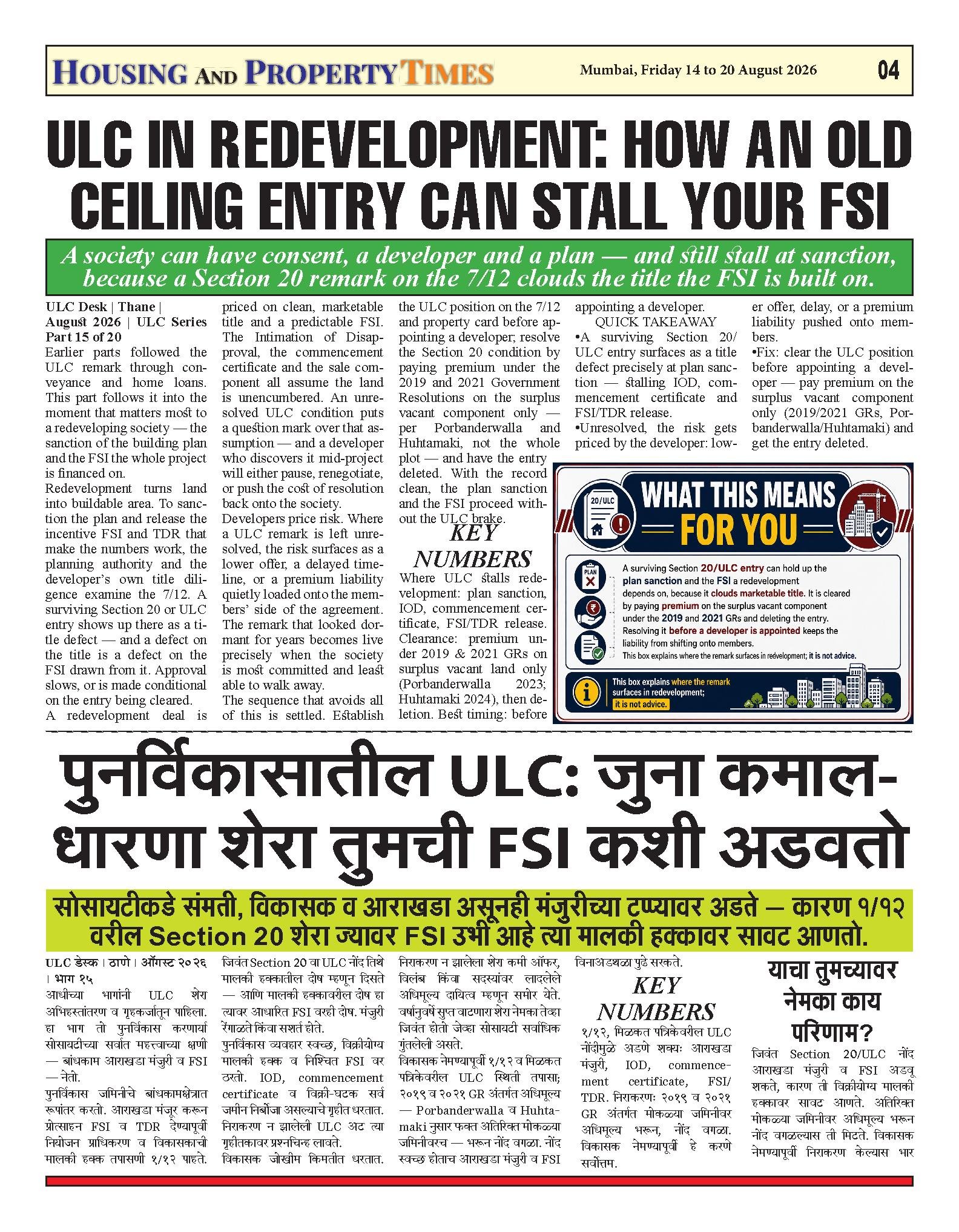
ULC IN REDEVELOPMENT: HOW AN OLD CEILING ENTRY CAN STALL YOUR FSI
Page 4
ULC IN REDEVELOPMENT: HOW AN OLD CEILING ENTRY CAN STALL YOUR FSI
 Page 5
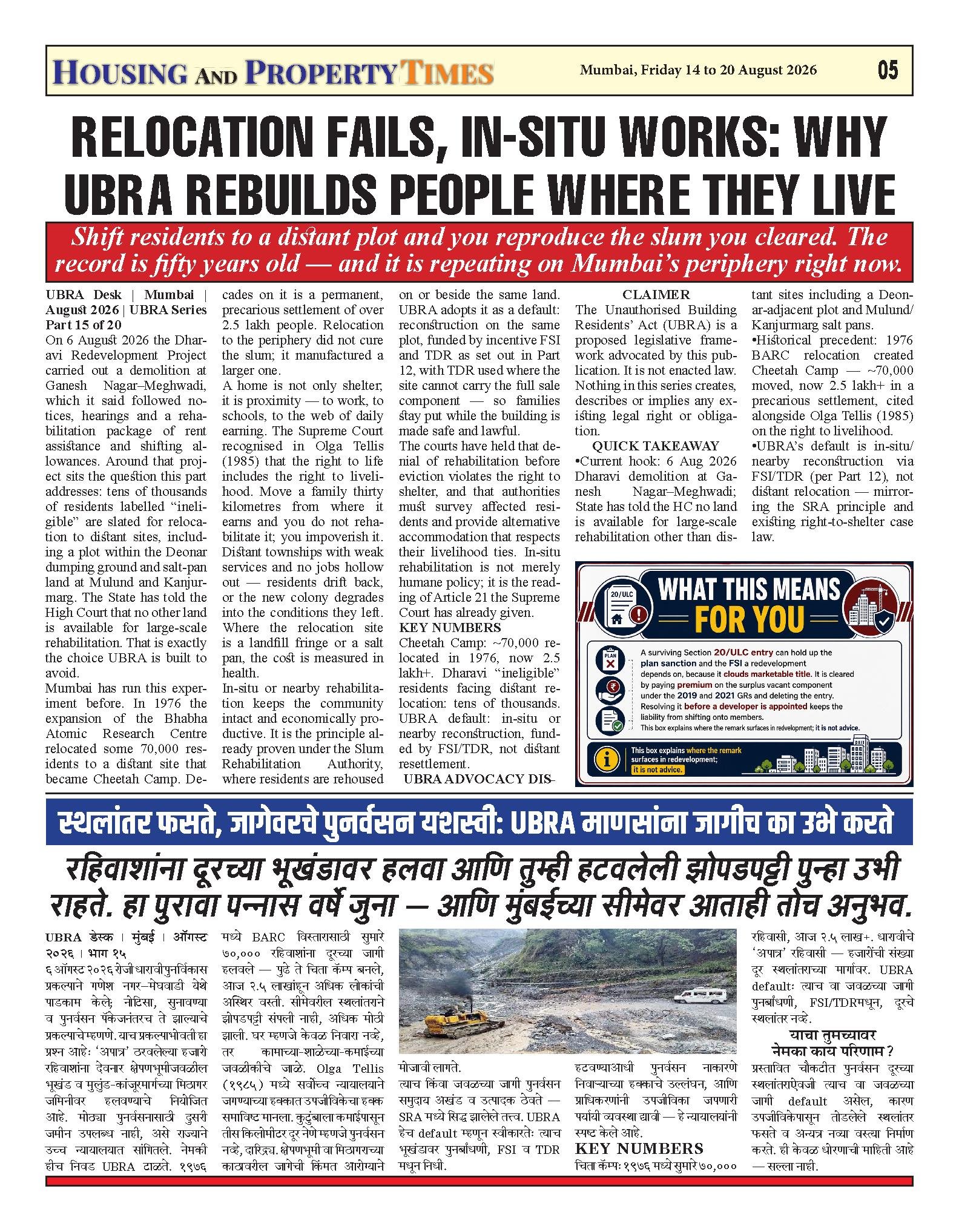
RELOCATION FAILS, IN-SITU WORKS: WHY UBRA REBUILDS PEOPLE WHERE THEY LIVE
Page 5
RELOCATION FAILS, IN-SITU WORKS: WHY UBRA REBUILDS PEOPLE WHERE THEY LIVE
 Page 6
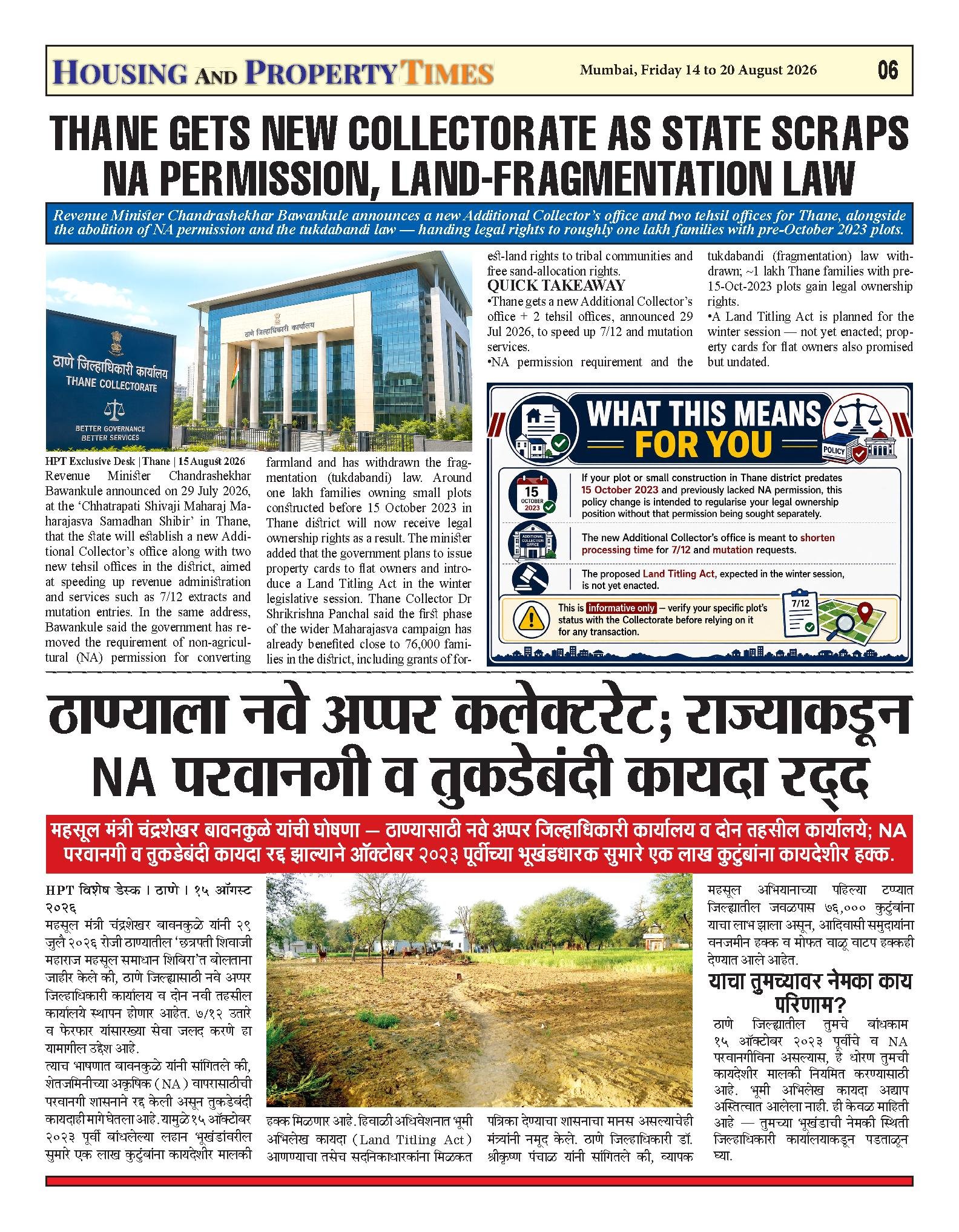
THANE GETS NEW COLLECTORATE AS STATE SCRAPS NA PERMISSION, LAND-FRAGMENTATION LAW
Page 6
THANE GETS NEW COLLECTORATE AS STATE SCRAPS NA PERMISSION, LAND-FRAGMENTATION LAW
Comments (0)